News + Insights from the Legal Team at Zalkind Duncan & Bernstein

Archives

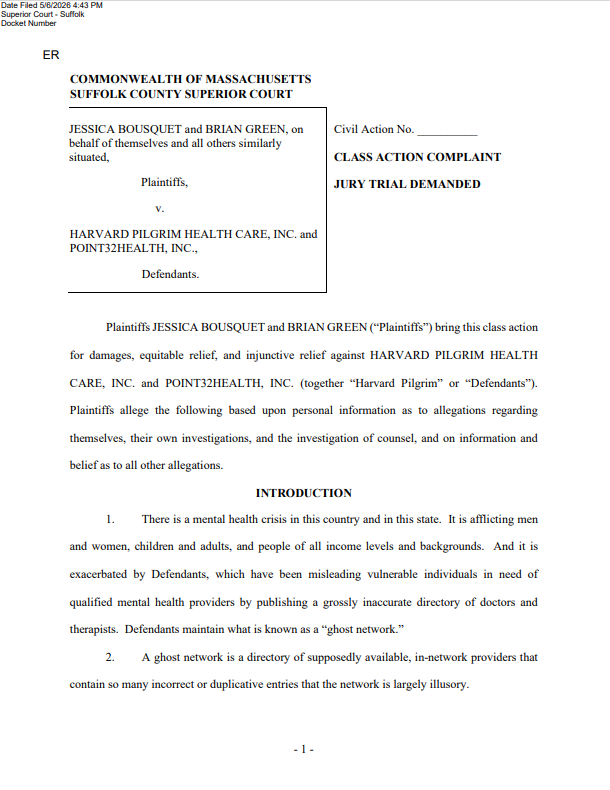
image-1Boston, Mass., May 6, 2026Pollock Cohen LLP, along with co-counsels Walden Macht Haran & Williams LLP, and Zalkind Duncan & Bernstein LLP have filed a class action lawsuit in Massachusetts state court against Harvard Pilgrim Healthcare and its parent company, Point32 Health alleging that its “ghost network” of mental health providers harmed thousands of people.

The lawsuit alleges that the defendants engaged in deceptive and fraudulent business practices by intentionally publishing an inaccurate directory of supposedly in-network doctors, therapists and other medical providers. A vast majority – upwards of 80% – of the doctors and therapists listed in the in the insurance company’s directory of supposedly in-network providers didn’t actually exist, didn’t accept the insurance, or wouldn’t take on new patients.

The suit focuses on the harm caused by business practices that make it very difficult and expensive to access mental healthcare.  “People pay an expensive premium to have access to what is represented is a robust network of providers; when in reality there are few doctors who actually participate. This is a classic bait-and-switch but with very serious health consequences,” said Steve Cohen of Pollock Cohen LLP, one of the attorneys representing the plaintiffs.
image

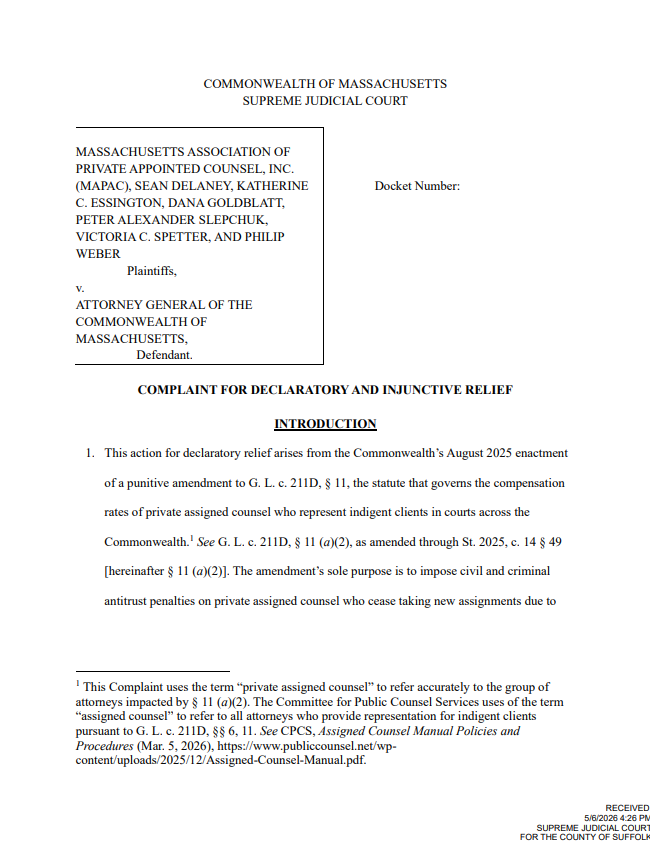
Zalkind Law filed a lawsuit yesterday on behalf of the Massachusetts Association of Private Appointed Counsel (MAPAC) and six defense attorneys from across the Commonwealth. At stake in this case is the ability of lawyers who represent indigent criminal defendants to advocate for fair compensation for that work.

The complaint challenges an August 2025 amendment to Massachusetts law (G.L. c. 211D, § 11(a)(2)), which unfairly and illegally imposes antitrust penalties on attorneys who decide to stop taking new cases until they are fairly compensated. The law violates basic constitutional rights to due process and free speech, as well as laws that have long-shielded workers. CONTINUE READING ›

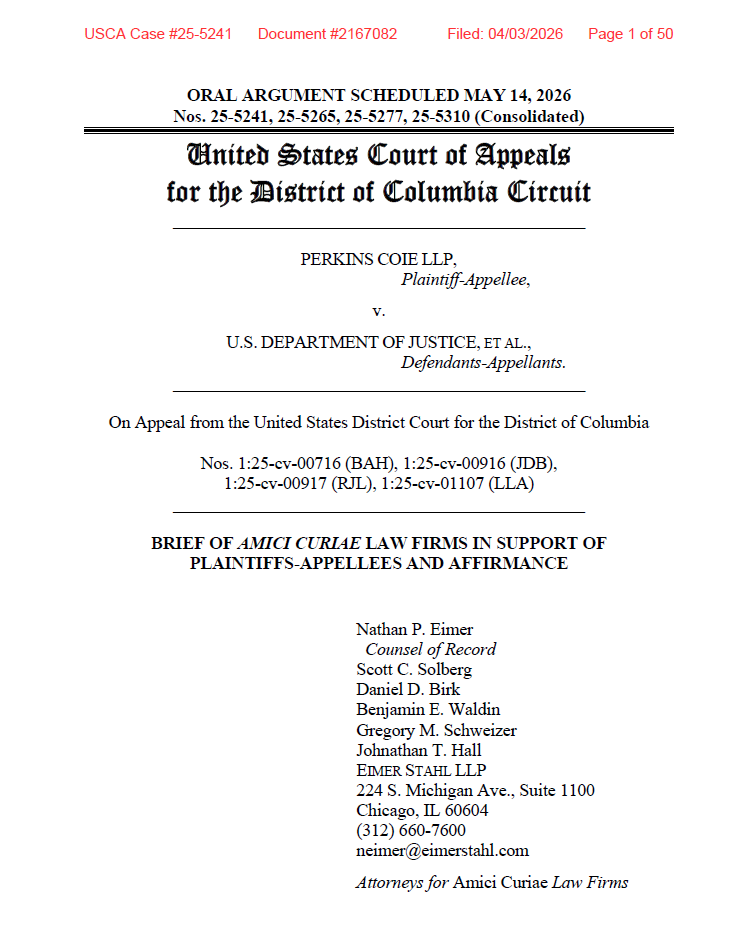
Screenshot-2026-04-03-192546Zalkind Duncan & Bernstein LLP is again proud to join more than 800 other law firms in an amicus brief supporting Perkins Coie’s challenge to the Trump administration’s executive order targeting that firm. Perkins Coie won an injunction against that order, which the Trump administration has appealed to the D.C. Circuit Court of Appeals. As a firm dedicated to representing individuals who stand up to the government and large institutions, Zalkind Law applauds Perkins Coie for resisting the administration’s attempts to bully and threaten law firms into abandoning the core values of the American justice system.

Read the full brief here.

Picture of Naomi ShatzWe are proud to announce that The Education Lawyers, a national, independent guide to education attorneys, has selected partner Naomi Shatz as its recommended attorney for Massachusetts. Naomi was selected based on peer and client nominations, and research by The Education Lawyers. “Peers regard Naomi as a leading voice in student rights and campus misconduct litigation. Clients commend her thoughtful counsel during emotionally charged Title IX matters, particularly where free speech, due process, and discrimination issues intersect within academic institutions,” The Education Lawyers writes. Each year The Education Lawyers selects one attorney from each state to recommend.

Read Naomi’s bio here


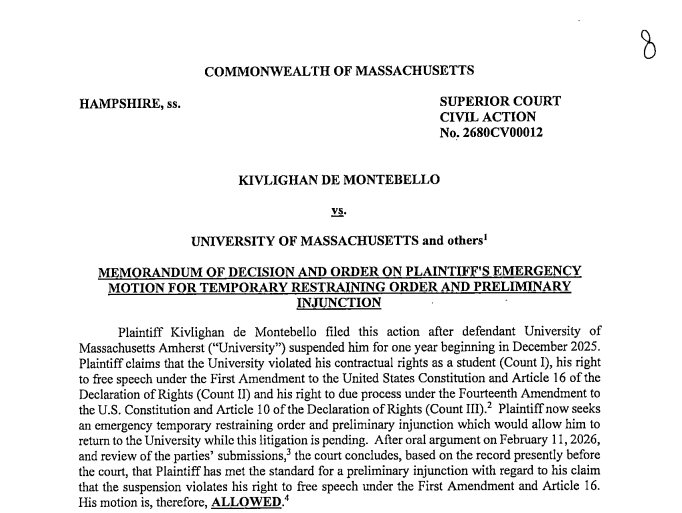
de-Montebello-roderOn February 13, 2026 a court enjoined UMass Amherst from suspending student Kivlighan de Montebello for his participation in an on-campus protest in September, finding that the suspension likely violates his free speech rights. The firm and the National Lawyers Guild sued the university last month after de Montebello’s suspension was imposed. On Friday a judge in the Hampshire Superior Court found that the behavior the suspension was based on–chanting outside of an on-campus career fair–did not cause a “substantial disruption” to a university activity as would be required for the punishment to be constitutional. CONTINUE READING ›

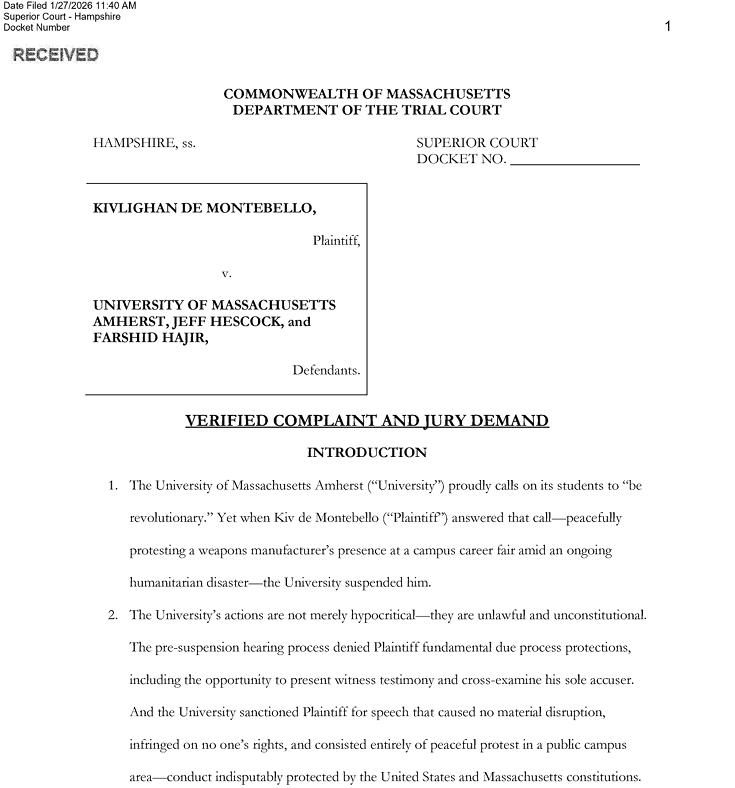
photo-de-Montebello-complaintYesterday attorneys Naomi R. Shatz and Jackson Estrin along with the National Lawyers Guild filed a free speech and due process lawsuit against UMass Amherst.  The lawsuit stems from a peaceful protest of Raytheon, which was recruiting at a campus career fair in September. Although the approximately two dozen protesters were peaceful and did not enter or disrupt the career fair, campus officials ordered them to leave the student center where they were holding the protest then disciplined Kivlighan de Montebello, the plaintiff in the suit, for exercising his free speech rights, suspending him for a year. The lawsuit is filed in Hampshire Superior Court and seeks an emergency restraining order and preliminary injunction ordering the University to overturn the suspension and allow de Montebello to resume his studies this semester.

“The Constitution protects peaceful protest, period,” says attorney Naomi R. Shatz. “Universities can’t punish students for exercising their First Amendment rights just because administrators find the message inconvenient.” CONTINUE READING ›

Emma Quinn-JudgeToday in Commonwealth v. McCaffrey, the Supreme Judicial Court reversed all of our client’s most serious convictions and set aside those verdicts, remanding the case for resentencing. The SJC’s decision affirms the fundamental principle that a criminal indictment may never be substantively amended: “[s]ubstantive amendments are constitutionally defective regardless of whether they would prejudice the defense,” because they create a “substantial risk that the defendant was convicted of a crime for which he was not indicted by a grand jury.”

In reaching this conclusion, the SJC reversed the Appeals Court decision holding that the amendments in this case were not substantive. See Commonwealth v. McCaffrey, 104 Mass. App. Ct. 642, 645-48 (2024). The SJC agreed with Attorney Quinn-Judge that changing the offense from one subsection of a statute to another subsection of the same statute was in fact a substantive change, requiring reversal.

Read media coverage of Emma’s win here:

It is wiFull-length black and white portrait of Norman Zalkindth heavy hearts we announce the passing of Norman Zalkind, our friend, mentor, and Zalkind Duncan & Bernstein’s founder. Norman died peacefully at his home, surrounded by family on December 20. He was 87.

Norman was one-of-a-kind. An exceptionally skilled trial lawyer and vigorous advocate for his clients, he fought to win. He taught generations of lawyers how to try cases: approaching each case with creativity, each legal challenge with rigor, and each jury with the story he crafted for them to hear.  All the partners now at the firm, and many others in the legal community with whom he worked over the years, are the lawyers they are today in large part because of having had the opportunity to work with and learn from him.

Norman grew up in Brookline and attended Boston College and Boston University School of Law, after which he began his legal career as a civil rights lawyer. In 1964, at age 25, he traveled to Louisiana and Mississippi where he represented hundreds of people who were arrested protesting for civil rights. When he returned to Boston, he continued his criminal defense work on behalf of those arrested in mass protests for civil rights and against the Vietnam War. In 1969 he represented over 180 students arrested in the takeover of Harvard’s University Hall protesting the war. When he won acquittals on the first twenty cases he took to trial, the judge dismissed the rest of the charges. Norman spent the next six decades as one of Boston’s most accomplished criminal defense attorneys. Over his storied career he tried more than 130 cases before a jury, securing not guilty verdicts in cases ranging from fraud to murder.

Zalkind Law has filed an amicus (“friend of the court”) brief with the Supreme Judicial Court on behalf of Jane Doe Inc., the Victim Rights Law Center, the Women’s Bar Association of Massachusetts, and the Massachusetts Employment Lawyers’ Association on the scope of the state anti-sexual harassment law. The case, Sabatini v. Knouse, is a lawsuit brought by former MIT scientist David Sabatini against Kristin Knouse, a former MIT graduate student and employee who made sexual harassment allegations against Sabatini. The question the Supreme Judicial Court will address when it hears the case next month is whether Massachusetts’ statute prohibiting sexual harassment (G.L. c. 214, § 1C), allows Knouse to bring a claim against Sabatini himself, or only allows claims against institutions when the sexual harassment occurs in the educational context.

The brief, authored by Zalkind Law attorneys Naomi R. Shatz and Niamh Gibbons, explains that the law clearly allows suits against the individuals who perpetrate harassment in the education context, just as the courts have already held it allows suits against those individuals who harass others in the employment context. The language of the statute, the requirement that civil rights statutes be read broadly, and the Legislature’s intent to create a comprehensive statutory scheme for addressing sexual harassment at school and at work all support Knouse’s ability to bring this claim.

Read the brief here.

Emma Quinn-JudgeThe Appeals Court vacated the convictions of our firm’s client, concluding that the Commonwealth “presented evidence that repeatedly violated the first complaint rule” that came from “no fewer than five witnesses and a written exhibit,” and to which the prosecutor specifically directed the jury’s attention during her closing argument. Specifically, the Commonwealth elicited impermissible testimony from multiple witnesses, introduced medical records that included impermissible commentary, and repeatedly presented evidence about the fact of the defendant’s arrest and the police investigation as a whole. The Appeals Court concluded that the “prejudicial effect of the repeated complaints was strong enough to have materially influenced the jury’s ultimate verdicts” and vacated the defendants’ convictions.

Justia Lawyer Rating
Super Lawyers
Martindale-Hubbell
Best Lawyers
Best Law Firms
Chambers Spotlight MA 2026
Contact Information