News + Insights from the Legal Team at Zalkind Duncan & Bernstein

Archives

It is wiFull-length black and white portrait of Norman Zalkindth heavy hearts we announce the passing of Norman Zalkind, our friend, mentor, and Zalkind Duncan & Bernstein’s founder. Norman died peacefully at his home, surrounded by family on December 20. He was 87.

Norman was one-of-a-kind. An exceptionally skilled trial lawyer and vigorous advocate for his clients, he fought to win. He taught generations of lawyers how to try cases: approaching each case with creativity, each legal challenge with rigor, and each jury with the story he crafted for them to hear.  All the partners now at the firm, and many others in the legal community with whom he worked over the years, are the lawyers they are today in large part because of having had the opportunity to work with and learn from him.

Norman grew up in Brookline and attended Boston College and Boston University School of Law, after which he began his legal career as a civil rights lawyer. In 1964, at age 25, he traveled to Louisiana and Mississippi where he represented hundreds of people who were arrested protesting for civil rights. When he returned to Boston, he continued his criminal defense work on behalf of those arrested in mass protests for civil rights and against the Vietnam War. In 1969 he represented over 180 students arrested in the takeover of Harvard’s University Hall protesting the war. When he won acquittals on the first twenty cases he took to trial, the judge dismissed the rest of the charges. Norman spent the next six decades as one of Boston’s most accomplished criminal defense attorneys. Over his storied career he tried more than 130 cases before a jury, securing not guilty verdicts in cases ranging from fraud to murder.

Zalkind Law has filed an amicus (“friend of the court”) brief with the Supreme Judicial Court on behalf of Jane Doe Inc., the Victim Rights Law Center, the Women’s Bar Association of Massachusetts, and the Massachusetts Employment Lawyers’ Association on the scope of the state anti-sexual harassment law. The case, Sabatini v. Knouse, is a lawsuit brought by former MIT scientist David Sabatini against Kristin Knouse, a former MIT graduate student and employee who made sexual harassment allegations against Sabatini. The question the Supreme Judicial Court will address when it hears the case next month is whether Massachusetts’ statute prohibiting sexual harassment (G.L. c. 214, § 1C), allows Knouse to bring a claim against Sabatini himself, or only allows claims against institutions when the sexual harassment occurs in the educational context.

The brief, authored by Zalkind Law attorneys Naomi R. Shatz and Niamh Gibbons, explains that the law clearly allows suits against the individuals who perpetrate harassment in the education context, just as the courts have already held it allows suits against those individuals who harass others in the employment context. The language of the statute, the requirement that civil rights statutes be read broadly, and the Legislature’s intent to create a comprehensive statutory scheme for addressing sexual harassment at school and at work all support Knouse’s ability to bring this claim.

Read the brief here.

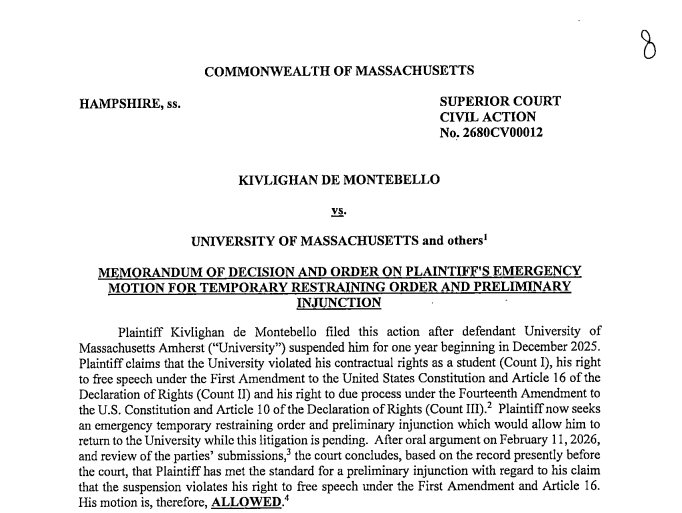
The Appeals Court vacated the convictions of our firm’s client, concluding that the Commonwealth “presented evidence that repeatedly violated the first complaint rule” that came from “no fewer than five witnesses and a written exhibit,” and to which the prosecutor specifically directed the jury’s attention during her closing argument. Specifically, the Commonwealth elicited impermissible testimony from multiple witnesses, introduced medical records that included impermissible commentary, and repeatedly presented evidence about the fact of the defendant’s arrest and the police investigation as a whole. The Appeals Court concluded that the “prejudicial effect of the repeated complaints was strong enough to have materially influenced the jury’s ultimate verdicts” and vacated the defendants’ convictions.

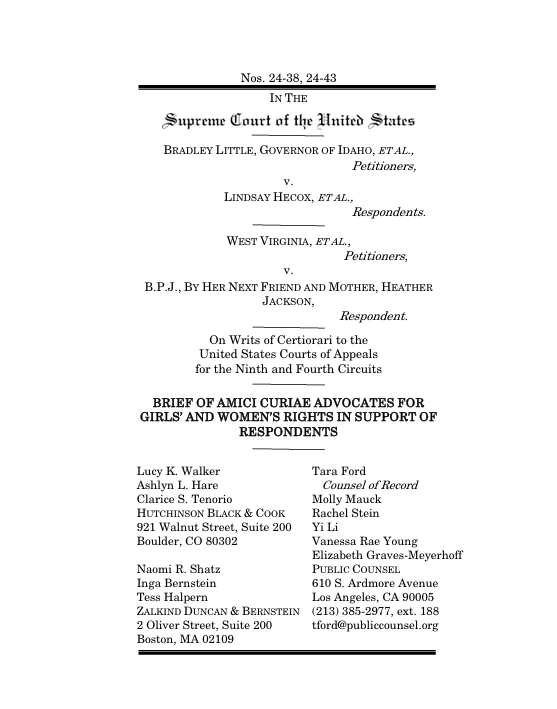
Picture of amicus brief coverZalkind Law, along with Public Counsel and Hutchinson Black and Cook, filed an amicus brief with the Supreme Court in support of transgender female athletes challenging their states’ bans on transgender girls’ participation in girls’ athletics. The cases are West Virgina v. BPJ and Little v. Hecox. The brief, written on behalf of sixteen women’s and girls’ advocacy groups, illustrates how transgender sports bans harm all women and girls who want to participate in sports. By imposing invasive sex verification procedures on girls’ sports teams (but not boys’ teams), these laws subject girls to unnecessary and expensive medical procedures to prove they are entitled to participate in sports. These laws feed into a long history of excluding women from sports, target any girls whose bodies or talents deviate from stereotypes of femininity or girlhood, and serve as a tool for harassment and abuse of female athletes. Zalkind Law is proud to contribute our work towards the effort to achieve the dream of Title IX: one where all girls and women have access to athletic programs where they can achieve their full potential.

The brief is available here.

Attorneys Naomi Shatz, Inga Bernstein, and Tess Halpern drafted this brief on behalf of Zalkind Law.

Zalkind Duncan & Bernstein LLP is proud to announce that all eight of the firm’s attorneys, and two of the firm’s of-counsel attorneys, were named in the 2026 edition of Best Lawyers in America.

In addition, Inga Bernstein was named “Lawyer of the Year” for Employment Law – Individuals, and David Duncan was named “Lawyer of the Year” for Appellate Practice.

Best Lawyers is the oldest and most respected peer-review publication in the legal profession and rates attorneys by conducting exhaustive peer-review surveys in which tens of thousands of leading lawyers confidentially evaluate their professional peers. Congratulations to all!

Emma-scaledAttorney Emma Quinn-Judge won an appeal of an assault and battery conviction in the Appeals Court. In Commonwealth v. Jeudin, the firm’s client was charged with strangulation. After the Commonwealth rested its case, Mr. Jeudin moved for–and the judge granted–a required finding of not guilty because the Commonwealth had not proved the elements of strangulation. The judge then reduced the charge to assault and battery, and the jury convicted the client of that charge.

On appeal, Attorney Quinn-Judge argued that reducing the charge to assault and battery was improper because it allowed the jury to convict Mr. Jeudin for conduct that he was not charged with in the complaint, that assault and battery has at least one element strangulation does not have, and that Mr. Jeudin was further prejudiced by this change in charge because it impacted the strategic decisions he had made with respect to his trial. The Appeals Court agreed, finding that the amendment of the charge let the jury convict the client for a crime that was not alleged in the complaint against him, based on different actions than those alleged in the complaint. The Appeals Court further found that this error prejudiced Mr. Jeudin, and reversed the judgment against him.

Copy-of-LinkedIn-Police-Questioning

The process for sealing a criminal record in Massachusetts has changed significantly in recent years due to amendments to the sealing statute and new court decisions. Zalkind Law attorneys David Russcol and Niamh Gibbons explain the current state of the law and provide practical tips for attorneys helping clients navigate the process, including those seeking to file in court to seal records of dismissed or nol prossed charge before they are eligible to be sealed through the more straightforward administrative process. 

Sealing State Criminal Records: A Practitioner’s Guide

Zalkind Duncan & Bernstein LLP is proud to join more than 500 other law firms in an amicus brief supporting Perkins Coie’s challenge to the Trump Administration’s executive order targeting that firm. As a firm dedicated to representing individuals who stand up to the government and large institutions, Zalkind Law applauds Perkins Coie for resisting the administration’s attempts to bully and threaten law firms into abandoning the core values of the American justice system.

Read the full brief here

View the list of law firms here

Photograph of Ana MuñozThe Women’s Bar Association of Massachusetts has selected Ana Muñoz to participate in the 2024-2025 Women’s Leadership Initiative, a program that provides mentoring and leadership development for women attorneys in Massachusetts who have been identified as the rising stars of the profession. WBA President Alexandra Mitropoulos said, “The WBA is so pleased that Ana Muñoz will join as a member of the new class of the WBA’s Mary K. Ryan Women’s Leadership Initiative. The program is directly aligned with the WBA’s goal of advancing women in the profession and we are certain that Ana will be a beacon for that important work. We are thrilled to have such a promising class, led by accomplished mentors committed to developing the next generation of women leaders.” Congratulations to Ana and all the other women leaders selected for this honor.

Read more about Ana here.


Ana-Isabel

Zalkind Duncan & Bernstein LLP is proud to announce that Ana Muñoz joins the firm’s partnership effective January 1, 2025.  Ana will continue her litigation practice in employment, complex civil litigation, civil rights, and criminal matters.  For more information about Ana’s background and experience, find her biography here.

Justia Lawyer Rating
Super Lawyers
Martindale-Hubbell
Best Lawyers
Best Law Firms
Chambers Spotlight MA 2026
Contact Information